
How to Organize Your Garage Inventory with QR Codes
If your garage has slowly turned into a black hole of unlabeled bins, tangled cords, and tools you swear you own but can never find, you’re not alone. Most garages start out organized and end up as a dumping ground within a year. The good news is that fixing this doesn’t require a full renovation or a weekend of frustration — it just requires a smarter system. That’s where QR codes come in, and it’s the exact problem Elephant Trax was built to solve.
Instead of relying on memory, sticky notes, or vague labels like “misc tools,” a QR-based garage inventory system lets you scan a code and instantly see everything inside a bin, shelf, or toolbox — no digging required.
Why Garage Inventory Gets Out of Control
Garages tend to collect a strange mix of items: seasonal decorations, sports gear, power tools, car parts, paint cans, and boxes from three moves ago. Because so many categories overlap in one space, traditional labeling breaks down fast. A handwritten label tells you what a bin was for, not what’s actually inside it six months later.
This is the core issue with most garage organization attempts — the system only works until someone adds or removes an item and forgets to update the label. A garage inventory system needs to be dynamic, not static, which is exactly why a printed label falls short compared to a scannable one.
How QR Codes Solve the Garage Chaos Problem
A QR code label doesn’t hold information itself — it links to information. That distinction matters. With Elephant Trax, each label connects to a digital record that you control from your phone. You can attach photos, item lists, and notes to a single QR code, and update that record any time your bin’s contents change, without ever printing a new label.
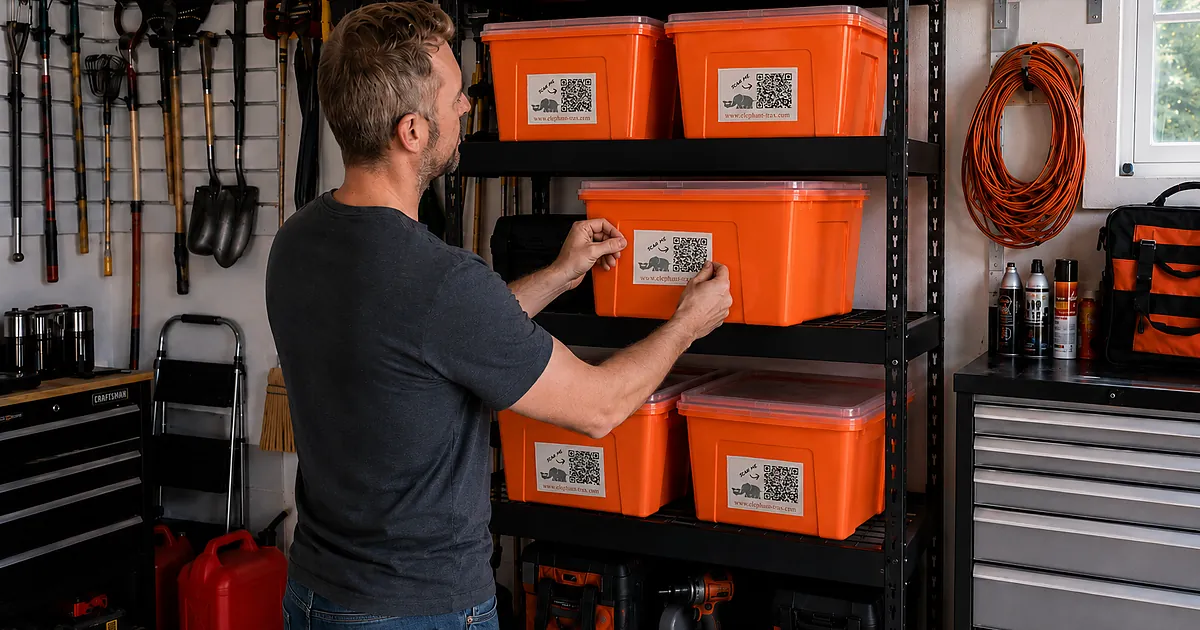
So instead of writing “holiday lights, extension cords, spare bulbs” on a piece of tape that fades and peels, you simply scan QR code stickers placed on the bin, and your phone pulls up the current contents — updated as recently as last week, not three years ago.
This turns garage inventory from a one-time labeling project into an ongoing, low-effort system that actually stays accurate.
Setting Up Your Garage Inventory System Step by Step
1. Sort before you label. Group items by category first — tools, automotive, seasonal, sporting goods, hardware. Trying to label mid-sort usually creates more confusion, not less.
2. Assign a QR label to every container. Every bin, drawer, shelf section, or toolbox gets its own unique QR code label. Stick it somewhere visible and flat, ideally at eye level or on the lid.
3. Build the digital record. Open the app, scan the code, and add photos or a written list of what’s inside. This step is what separates a real inventory system from a basic label — the data lives with the code, not just on the container.
4. Add searchable keywords. Tag items with keywords so you can search “drill bits” or “camping gear” across your entire garage instead of scanning bin by bin when you’re not sure where something landed.
5. Update as you go. Whenever you add or remove something, open the app and edit that bin’s record. This is the habit that keeps the whole system honest over time.
Shop QR Codes to Get Started
You don’t need a complicated setup to begin — just durable, scannable labels and a few minutes per bin. Elephant Trax offers pre-made QR label packs designed specifically for storage bins, toolboxes, and garage shelving, so you can shop QR codes suited to garage conditions (dust, temperature swings, occasional grease) rather than using flimsy office labels that peel or fade. Whether you’re organizing a small home garage or a shared workshop space, having the right physical labels on hand makes the difference between a system you set up once and actually maintain, versus one you abandon after a month.
Best Practices for Long-Term Garage Organization
- Group similar items under one code instead of creating a new label for every single object. A bin of hand tools can be one entry with a full list inside.
- Keep a consistent placement rule — always put labels on the same corner or side of every bin so scanning becomes second nature.
- Do a seasonal check-in. Twice a year, walk through the garage and confirm your digital records still match what’s physically there.
- Use photos, not just text. A quick photo of a bin’s contents is often faster to scan visually than reading a list, especially for oddly shaped items like cables or hardware.
- Loop in the household. If multiple people use the garage, shared access means everyone can scan a code and know exactly what’s inside — and put things back correctly.
Why This Matters Beyond the Garage
A garage inventory system built on QR codes isn’t just about tidiness — it saves real time. No more buying a second hammer because you couldn’t find the first one, and no more emptying five bins looking for the right screwdriver bit. Every time you scan a QR code, you get an immediate, accurate answer instead of a guess.
It also scales with you. The same system that organizes a single garage wall works just as well for a home workshop, a small business storage room, or shared community equipment — because the labels don’t need to change, only the digital contents behind them do.
Final Thoughts
Garage organization fails most often because the labeling can’t keep up with real life. QR codes fix that by separating the physical label from the information itself, letting you update contents any time without reprinting anything. Start small — sort one shelf, label it, scan it, and build the habit from there. Once you experience how fast it is to scan a QR code and instantly know what’s inside a bin, going back to handwritten labels will feel like a step backward.

