
The Moving Box Hack You’ll Wish You Knew Before Moving
Moving day has a way of turning even the calmest household into a maze of cardboard. You tape up box after box, promise yourself you’ll remember what went where, and then spend the first week in your new home tearing through ten different containers just to find a phone charger. If that sounds familiar, you’re not alone — and the good news is that the fix isn’t more tape or bigger boxes. It’s a smarter system for tracking what’s inside them.
At Elephant Trax, we work with people packing up entire households every day, and the pattern is always the same: the moves that go smoothly aren’t the ones with the fanciest supplies — they’re the ones with a plan for tracking every moving box from driveway to new doorway. Below is the hack that changes everything, along with the habits that make it stick.
Why Traditional Box Labeling Falls Short
For decades, the standard move has been to grab a marker and scribble “Kitchen” or “Misc” on the side of a box. It feels productive in the moment, but it creates problems the second boxes start stacking up:
- Handwriting smudges, fades, or gets covered by other boxes stacked on top
- “Misc” tells you nothing about what’s actually inside
- You still have to open the box to confirm the contents
- There’s no way to search across dozens of boxes at once
By the time you’ve packed 40 or 50 boxes, a single word on cardboard just isn’t enough information. You need a system that works the way your brain actually searches for things — by item, not by guesswork.
The Hack: Pair Every Box With a Digital Box Inventory List
Here’s the shift that makes the biggest difference: instead of relying on a marker alone, create a Box Inventory List as you pack, and attach a scannable label to the outside of each box that links straight to that list.
The process is simple:
- As you fill a box, snap a quick photo or jot down the key items going inside
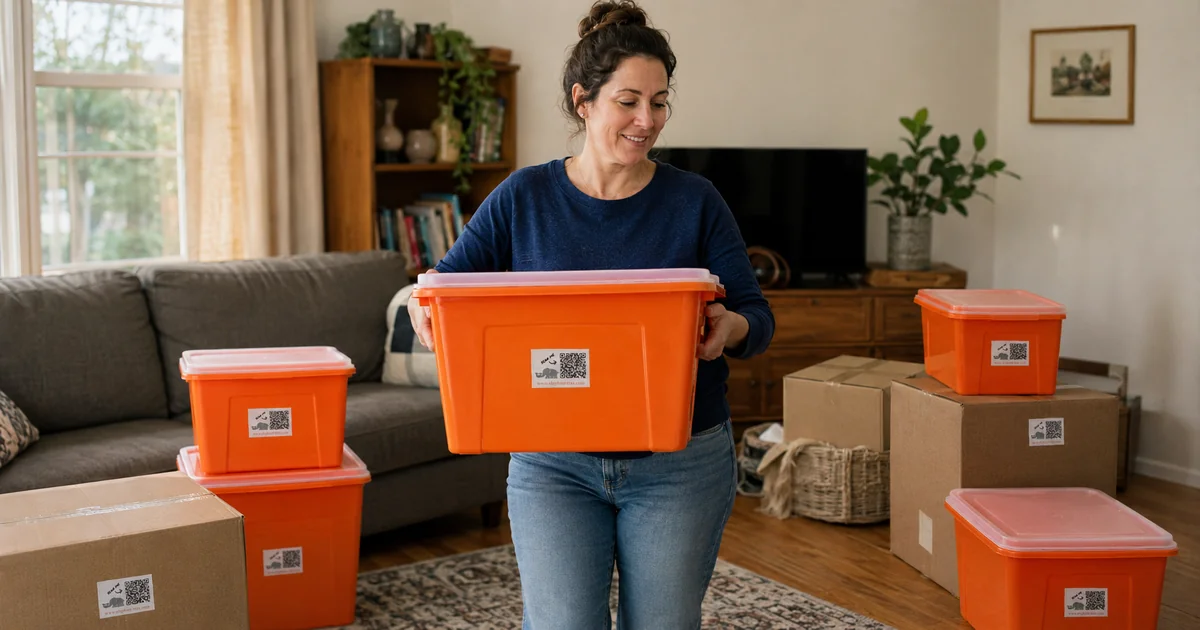
- Attach a QR label to the box
- Scan the label with your phone to instantly pull up everything packed inside — no digging required
This is exactly the approach behind Elephant Trax’s moving inventory system. Instead of opening a box to check whether it holds winter coats or holiday decorations, you scan the label and see the contents, photos, and notes right on your phone. Multiply that by every box in your move, and you’ve essentially built a searchable map of your entire household.
Turning Random Boxes Into Organized Storage Bins
A moving box doesn’t have to disappear into storage the moment you tape it shut. Treat each one like a mini storage unit with its own identity. This is where the difference between a pile of boxes and a set of organized storage bins really shows up.
A few habits make this easy to maintain:
- Group by room, not by convenience. Pack bathroom items together, garage tools together, and so on — mixing categories is the fastest way to lose track of things later.
- Use uniform bin sizes where possible. Matching containers stack more safely in a truck or storage unit and make loading far more efficient.
- Leave breathing room for fragile items. Overpacked bins shift during transport and are more likely to arrive damaged.
- Log contents digitally, not just on paper. A written list on your kitchen counter is easy to lose in the chaos of moving day. A digital list tied to a scannable label travels with the box itself.
When your storage bins are organized this way, unpacking becomes a matter of priority, not panic. You can search your inventory for “coffee maker” and know immediately which bin to open first, instead of unstacking half the garage.
Labeled Boxes That Actually Work
The word “labeled” gets used loosely in the moving world, but there’s a real difference between a box with a word on it and a box with a functional label. Labeled boxes that genuinely help you move should answer three questions at a glance: What’s inside? Which room does it belong in? And is anything fragile or high-priority?
A smart labeling system covers all three by combining:
- A short physical description on the box (for quick visual sorting)
- A destination room, so movers or family members know where to set it down
- A scannable QR code linked to the full contents list, powered by an app like Elephant Trax
This combination means you’re never relying on memory alone. Even if ten boxes are marked “Bedroom,” scanning each one tells you instantly which holds bedding, which holds books, and which holds the lamp you need on night one in the new house.
Building Your Moving Day Workflow
Here’s how the hack fits together in practice, from the first box you pack to the last one you unload:
Before packing: Set up your inventory system. Whether you’re using an app or a spreadsheet, decide how you’ll record contents before the first box gets sealed.
While packing: Add each item to your Box Inventory List as you go, and photograph anything valuable or easily forgotten. Attach a QR label immediately, while the box is still open and the contents are fresh in your mind.
During loading: Group boxes by room and priority. Load “open first” boxes last so they come off the truck first.
During unpacking: Scan labels to search for specific items instead of opening every box in sequence. This alone can save hours over a multi-day unpacking process.
After the move: Keep the labels and digital records if boxes are heading into long-term storage. A garage or storage unit full of organized bins with scannable labels means you’ll never have to “just open a few boxes to check” again.
Where to Get Started
You don’t need to build this system from scratch. Elephant Trax offers pre-printed QR labels designed specifically for moving and home storage, along with an app that lets you snap photos, tag items, and generate a full Box Inventory List in minutes. Labels are available directly through the Elephant Trax shop, where each order comes with a scannable QR code reference you can attach straight to your boxes and bins, or through the Elephant Trax Amazon Store if you’d rather order through a marketplace you already use.
Final Thoughts
The real moving box hack isn’t a folding trick or a packing tape brand — it’s treating every box as a data point instead of a mystery. Once you commit to organized storage bins, properly labeled boxes, and a running Box Inventory List, moving stops being a guessing game. You’ll spend less time hunting through cardboard and more time actually settling into your new space. Next time you move, skip the sticky notes and scribbled guesses, and let a scan tell you exactly what’s inside.

