
Storage Box Inventory for Homes: Organize More With Less Effort
Every home eventually collects a maze of boxes and bins — holiday decorations, off-season clothes, kids’ outgrown toys, garage tools, and paperwork you swore you’d sort “someday.” If you’ve ever torn through five containers looking for one extension cord, you already know why a proper storage box inventory matters. It’s not about owning less; it’s about knowing exactly what you own and where it lives, so your home stays functional instead of chaotic. With the right system, and a little help from technology, keeping track of everything you’ve packed away becomes almost effortless.
Why a Storage Box Inventory Actually Matters
Most clutter problems aren’t caused by having too much stuff — they’re caused by not knowing what’s in the stuff you already have. Duplicate purchases, forgotten warranties, and hours wasted digging through the garage are all symptoms of the same issue: no visibility into your storage.
A structured inventory changes that. When every box has a record of its contents, you stop guessing and start finding. This is especially valuable for:
-
- Seasonal rotations (holiday decor, winter coats, camping gear)
-
- Home moves and downsizing
-
- Insurance documentation after damage or theft
-
- Shared households where more than one person needs access to the same storage
The goal isn’t a spreadsheet nobody updates. It’s a living system that stays accurate because it’s easy to maintain.
The Problem With Traditional Labeling
Sticky notes fade. Marker labels smudge. Handwritten lists get lost or become outdated the moment you add or remove an item. Traditional labeling tells you a box is “Christmas Stuff,” but it doesn’t tell you which ornaments, how many strands of lights, or whether the tree topper is even in there.
This vagueness is why so many organizing efforts fall apart within a few months. The system works great on day one and becomes useless by month three, because updating a paper label means finding a pen, finding the box, and remembering to do it at all.
How a Storage Inventory App Solves the Problem
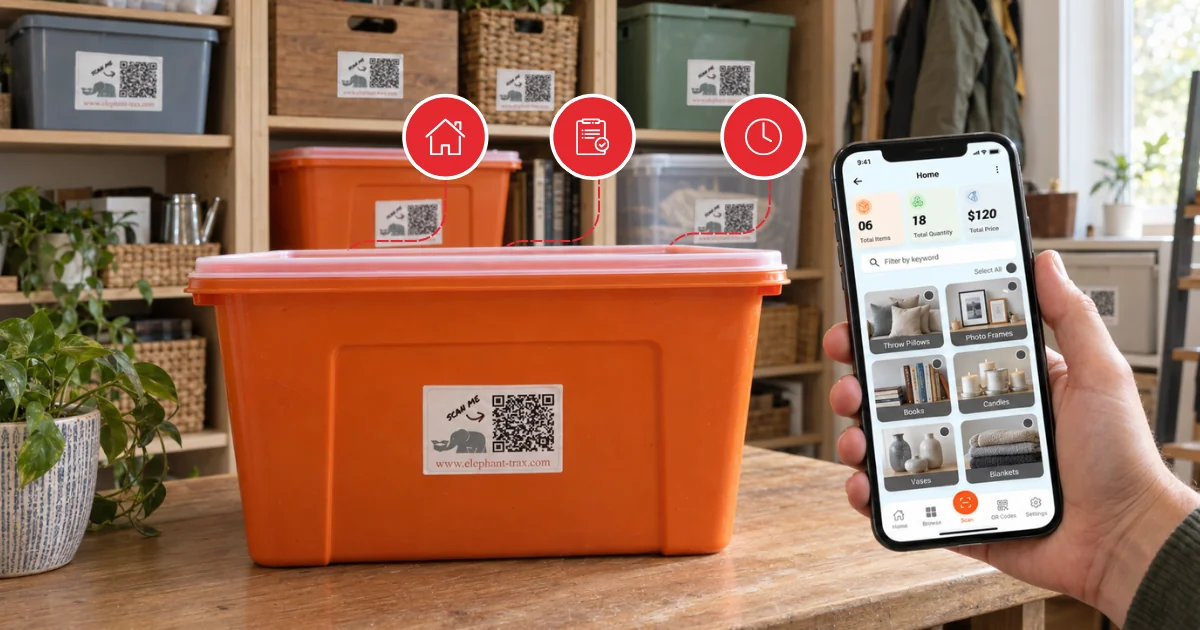
This is where a dedicated storage inventory app changes the entire experience. Instead of relying on memory or messy handwriting, you get a searchable digital record tied directly to each box. Platforms like Elephant Trax are built exactly for this: you photograph what’s going into a container, the app helps tag the items, and everything gets linked to a scannable code on the outside of the box.
The result is simple. Instead of opening ten bins to find your camping stove, you pull out your phone, search “camping stove,” and see instantly which box has it — without lifting a single lid.
What Makes a Good Storage App Worth Using
Not every organizing app is built the same way. A genuinely useful one should let you:
-
- Snap photos of items as you pack them
-
- Search your entire home inventory by keyword, not just by box name
-
- Share access with family members so everyone can find or add items
-
- Back everything up to the cloud so a lost phone doesn’t mean lost records
-
- Export or download reports, which is especially handy for insurance claims
Elephant Trax pairs these capabilities with AI-assisted tagging, so as you photograph an item, relevant keywords are suggested automatically instead of you typing everything out by hand. That single feature is often the difference between a system you maintain and one you abandon.
The Role of Storage Labels for Bins
Digital records only work if you can connect them to the physical container in front of you — and that’s exactly what storage labels for bins are designed to do. A scannable QR label turns an ordinary plastic bin into a searchable entry point for your entire inventory. Scan the code, and the app instantly shows what’s inside, complete with photos and notes, without you having to open the lid or remember which app entry matches which box.
Good bin labels should be:
Durable — able to survive garage temperature swings, moisture, and years of stacking without peeling or fading.
Easy to scan — readable at a glance with any smartphone camera, no special hardware required.
Reusable — if you empty and refill a bin, the label should let you update its contents rather than forcing you to print a new one.
Pairing physical labels with a digital system means the label itself never goes stale. You can completely repack a bin, update the app entry in seconds, and the same QR code still points to accurate, current information.
Setting Up Your Storage Box Inventory: A Simple Workflow
Getting organized doesn’t need to be an overwhelming weekend project. Here’s a workflow that works whether you’re tackling one closet or an entire garage.
1. Sort Before You Pack
Group similar items together before anything goes into a box. Mixing categories (tools with holiday decorations, for example) makes future searches harder, even with a digital system backing you up.
2. Photograph as You Go
As each box is filled, take a quick photo of the contents. This single habit is what makes a searchable inventory possible later — it’s much easier to snap a picture in the moment than to reconstruct a list from memory afterward.
3. Attach a Scannable Label
Stick a QR label on the outside of each box or bin, and link it to the digital entry you just created. From this point on, that label is the fastest way to check what’s inside.
4. Keep the System Updated
Whenever you add or remove something from a box, update the entry. Because scanning and editing takes seconds with an app like Elephant Trax, this step doesn’t become the chore that killed your last organizing attempt.
5. Share Access With Your Household
If more than one person uses the storage space, share access to the inventory. Everyone benefits from being able to search for what they need instead of asking “have you seen the…?”
Real Benefits Beyond a Tidy Garage
An organized storage system pays off in ways that go beyond aesthetics:
-
- Time savings — searching a database takes seconds compared to physically searching boxes
-
- Fewer duplicate purchases — knowing you already own something stops impulse rebuys
-
- Smoother moves — every box is pre-documented, making unpacking dramatically faster
-
- Insurance readiness — photographic records of your belongings are invaluable after a loss
-
- Shared accountability — families and roommates stay on the same page about shared items
Final Thoughts
Managing a storage box inventory doesn’t have to mean spreadsheets, sticky notes, or hours of frustrated searching. Combining a smart storage inventory app with durable, scannable storage labels for bins gives you a system that actually keeps up with real life — one where finding what you need takes seconds, not an entire Saturday afternoon.
Whether you’re organizing a single garage shelf or an entire home’s worth of seasonal storage, the principle stays the same: pack once, tag it, label it, and let the technology do the remembering for you. That’s the difference between a home that feels cluttered and one that feels genuinely under control.

