How Smart QR Label Tracking Helps Prevent Lost Items
Losing track of belongings is one of the most common frustrations in daily life, whether it’s a missing box after a move, misplaced lab equipment, or a stack of unlabeled storage bins in the garage. The solution isn’t necessarily buying more storage containers — it’s knowing exactly what’s inside the ones you already have. That’s where smart qr label tracking comes in, turning ordinary boxes and bins into a searchable, findable inventory system.
Why Traditional Labeling Falls Short
For decades, people have relied on handwritten labels or sticky notes to identify what’s inside a box. The problem is obvious: labels fade, handwriting gets illegible, and a note that says “misc. kitchen stuff” tells you nothing useful six months later. When you’re searching for a single item — a phone charger, a holiday decoration, a lab kit — you often end up opening multiple containers just to find it. Multiply that across a garage, storage unit, or office, and hours get wasted every year on simple searching.
Traditional labeling also fails to scale. A household might manage a few dozen boxes, but a nonprofit distributing donations, a school tracking lab supplies, or an events company hauling AV gear across venues needs something that works across hundreds of items and multiple people. This is exactly the gap that smart tracking systems were built to close.
What Is Smart Label Tracking?
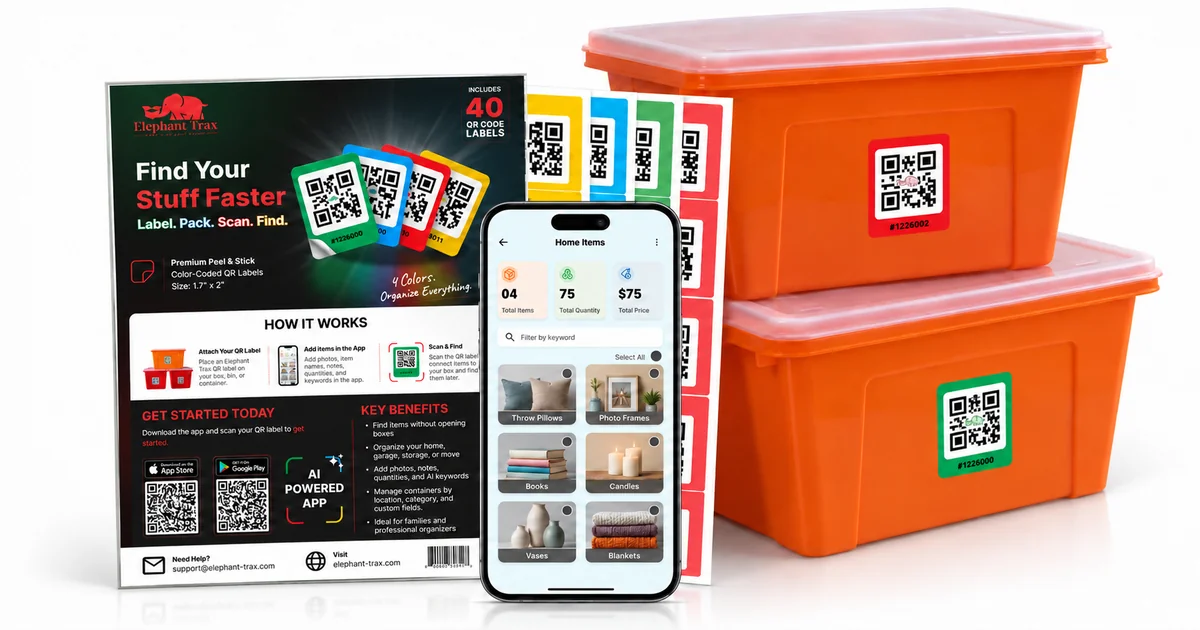
Smart label tracking pairs a physical label with a digital inventory record. Instead of writing a vague description on tape, you attach a smart QR label to a box, bin, or piece of equipment, then use an app to log what’s actually inside — photos, item names, quantities, and searchable keywords. The label itself becomes a doorway to real information, not just a static sticker.
This is the model behind platforms like Elephant Trax, where every label corresponds to a digital entry that anyone with access can view instantly. Instead of guessing what’s in a box, you scan the label and see the full contents on your phone — without ever opening the lid.
The Role of QR Code Tracking
At the center of this system is QR code tracking. A QR code is simple to generate, cheap to print, and scannable with virtually any smartphone camera — no special hardware required. When a QR code is linked to a cloud-based inventory record, scanning it pulls up everything associated with that container in seconds.
This is fundamentally different from writing a label by hand. A QR code can be updated at any time. If you move items between boxes, you simply update the digital record tied to that code — the physical label never needs to change. This flexibility is a major reason QR-based systems have become the standard for modern inventory and storage management, replacing static labels with dynamic, searchable data.
How Smart QR Labels Prevent Lost Items
The core benefit of smart qr labels is that they eliminate guesswork. Here’s how the process typically works:
- Label – Attach a QR label to a box, bin, tote, or piece of equipment.
- Log – Take a photo of the contents and add names, notes, quantities, or keywords through an app.
- Scan – Point your phone at the label anytime to instantly see what’s stored inside.
- Search – Look up an item by name across your entire inventory, and the app tells you exactly which box or label it’s stored in.
Because every item is tied to a specific label in a searchable database, nothing gets “lost” in the traditional sense. Even if a box gets shuffled to the back of a storage unit or moved to a different shelf, the digital record still knows what’s inside it. You’re no longer relying on memory or a scrawled note — you’re relying on a system that doesn’t forget.
This matters most in high-stakes or high-volume situations: a moving company managing hundreds of boxes across a multi-day move, a school checking lab kits in and out with students, or an AV team packing gear for back-to-back events. In each case, a missing or mislabeled item can mean lost time, lost money, or a scramble right before something important happens. Smart qr label tracking removes that risk by making every container’s contents instantly verifiable.
Beyond Finding Items: Preventing Loss in the First Place
Smart tracking doesn’t just help you locate things after they’re already misplaced — it helps prevent loss altogether. When every item is documented with a photo and description tied to a label, you naturally build a complete record of what you own. This has a few practical effects:
- No duplicate purchases. Knowing exactly what’s already stored means you won’t buy something you already own but forgot about.
- Shared visibility. Multiple people — family members, coworkers, or team members — can access the same inventory, so nobody is the sole keeper of “where things are.”
- Accountability during handoffs. For businesses and nonprofits managing shared equipment or donations, a shared digital inventory means less confusion about who has what and where it went.
- Faster insurance claims. If something is lost, stolen, or damaged, having photographic and written records of stored items already documented makes recovery and claims far easier.
Who Benefits Most From Smart Label Tracking
While this approach is popular for home organization — closets, garages, and storage units — the same principles apply well beyond the household. Nonprofits use shared QR-based inventories to manage donations and program kits. IT departments track devices and peripherals across offices. Schools and labs let students check equipment in and out without losing track of supplies. Event and AV companies label gear once and scan on-site, avoiding the classic problem of a missing cable or prop after a long day of setup and teardown.
In every case, the pattern is the same: a physical label connected to a digital record removes the guesswork that leads to lost or misplaced items.
Final Thoughts
Lost items are rarely about carelessness — they’re about a lack of system. Smart label tracking, powered by QR code tracking and smart QR labels, gives people and organizations a reliable way to know exactly what they own and exactly where it is, without opening a single box. Platforms like Elephant Trax show how this approach scales from a single household garage to multi-location businesses, proving that the fastest way to stop losing things is to stop guessing about them in the first place.

