
How to Organize a Small Classroom Without Creating More Clutter
A small classroom can quickly feel crowded when books, art supplies, teaching materials, technology, worksheets, and student belongings compete for limited space. The solution is not simply adding more shelves or storage bins. Instead, the goal is to create a system where every item has a clear place and can be found without making the room feel overloaded.
A smart organization system can help teachers save time, keep supplies accessible, and create a calmer learning environment. With the right combination of storage, labeling, and digital inventory tracking, even a compact classroom can become easier to manage.
Start by Removing What You Don’t Need
Before buying new storage containers, take a careful look at what is already in the classroom.
Separate supplies into a few simple groups:
- Items used every day
- Items used occasionally
- Seasonal or special-project materials
- Broken, outdated, or duplicate supplies
If something has not been used for a long time and has no clear purpose, consider removing it. Decluttering first creates valuable space without requiring additional furniture.
Teachers can also avoid keeping duplicate supplies simply because they are difficult to locate. A clear inventory system makes it easier to know what is already available before purchasing more.
Give Every Classroom Supply a Home
One of the easiest ways to organize classroom storage is to assign each category a specific location.
For example, keep:
- Art materials together
- Science equipment in one designated area
- Worksheets and teaching resources in labeled folders
- Technology accessories in one container
- Extra stationery in a dedicated drawer or bin
The important part is consistency. Once a location has been assigned, return items to the same place after use.
For smaller rooms, vertical storage can also make a major difference. Wall shelves, pegboards, hanging organizers, and cabinet doors can provide useful storage without taking up valuable floor space.
Use Containers That Match the Space
Large storage boxes may look useful, but they can make a small classroom feel even more crowded. Choose containers according to the available shelf or cabinet space.
Clear bins are especially useful because teachers can see their contents without opening every container. Smaller boxes can be used inside larger cabinets to separate supplies by type.
Instead of having one large container labeled “Classroom Supplies,” create smaller categories such as “Markers,” “Craft Tools,” “Math Materials,” or “Technology Accessories.”
This makes retrieval faster and prevents one messy container from becoming a catch-all storage area.
Create a Simple Labeling System
Labels should make storage easier—not add another layer of work.
Use short, easy-to-read names that students and teachers can understand. For example:
Reading → Level 1
Art → Paint Supplies
Science → Lab Tools
Technology → Chargers
You can also use color categories to make different storage areas easier to recognize. For example, blue could represent reading materials while green represents science supplies.
For containers holding many smaller items, digital identification can make the system even more useful.
Use QR Codes for the Classroom
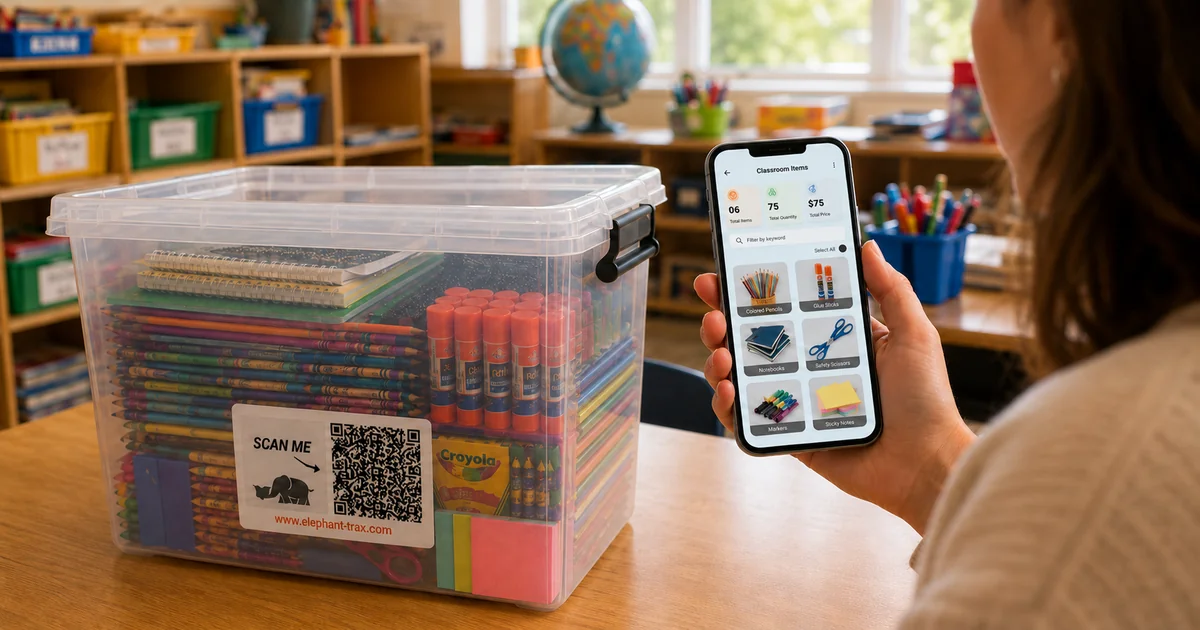
When a box contains multiple items, a traditional label may only tell you the general category. QR codes for the classroom can connect the physical container to a digital record.
For example, a teacher could place a QR label on a bin containing science experiment materials. Instead of opening the container to check its contents, the teacher can scan the code and view the information connected to that box.
Elephant Trax allows users to photograph items, add names and details, organize them into boxes, and connect those boxes to QR codes. When the code is scanned, the saved information can be viewed through the app.
This approach is particularly useful for materials that are stored away for several weeks or months. It provides a digital reference while keeping the physical classroom uncluttered.
Make Frequently Used Items Easy to Reach
Not every item needs to be stored in the same way.
Place frequently used materials where teachers and students can reach them easily. Items used only during special activities can go into cabinets or higher storage areas.
A useful rule is:
Daily use = easy access
Weekly use = nearby storage
Occasional use = deeper storage
This simple approach reduces unnecessary movement around the classroom and prevents frequently used supplies from getting buried behind less important items.
Create a Digital Inventory for Hidden Storage
The biggest organization challenge often comes from items that are stored out of sight.
A cabinet may contain several boxes, while each box may hold dozens of individual materials. After a few months, it becomes difficult to remember exactly where everything is.
Elephant Trax can help create a digital record by allowing users to add item photos, descriptions, keywords, quantities, and other information. Items can then be associated with specific boxes and locations.
Instead of opening multiple containers to find one resource, teachers can search the app or scan a connected QR label.
This is especially helpful when classrooms have limited storage and materials need to be packed away carefully.
Keep Student Access in Mind
A well-organized classroom should not depend entirely on the teacher.
Whenever possible, create simple systems that students can understand. Use clear labels, consistent locations, and easy-to-recognize categories.
For example, if students know that colored pencils always belong in one labeled container, they can return them independently after an activity.
This creates a classroom culture where organization becomes part of the daily routine rather than another task the teacher has to manage alone.
Avoid Over-Organizing
Organization can become counterproductive when there are too many categories, containers, labels, or complicated rules.
The best system is one that is easy to maintain.
If a storage method takes several minutes to use every time an item is returned, it probably will not last. Keep categories practical and make the process simple enough that everyone can follow it.
A small classroom does not need dozens of storage solutions. It needs a consistent system that makes the available space work harder.
Keep Your Classroom Organized Throughout the Year
Classroom organization should not be a once-a-year project. A five-minute reset at the end of each day can prevent clutter from building up.
Teachers can quickly check:
- Are supplies back in their assigned locations?
- Are frequently used items easy to reach?qr
- Are storage containers still being used correctly?
- Are labels still accurate?
- Are there materials that should be removed or relocated?
A short weekly review can also help update the digital inventory when new equipment or supplies are added.
With Elephant Trax, teachers can use the app to keep digital records connected to physical storage. The platform works across iOS, Android, and Web, making inventory information accessible from supported devices.
Make Small Spaces Smarter with Elephant Trax
If you want to simplify classroom storage without filling the room with more organizers, Elephant Trax offers a practical way to connect physical storage with digital information. You can photograph items, organize them into boxes, assign QR labels, and scan them later to see what’s inside. The education solution is designed for classrooms and equipment management, including cabinets, drawers, kits, and other shared materials.
You can shop Elephant Trax QR labels directly from the website, or purchase compatible physical labels through Amazon. The labels are designed to connect physical boxes and containers with digital inventory information, helping teachers find supplies without opening every box.
A small classroom does not need more clutter to become more organized. With thoughtful storage, clear categories, simple routines, and a digital tracking system, teachers can make limited space more functional while keeping essential materials easy to find.

